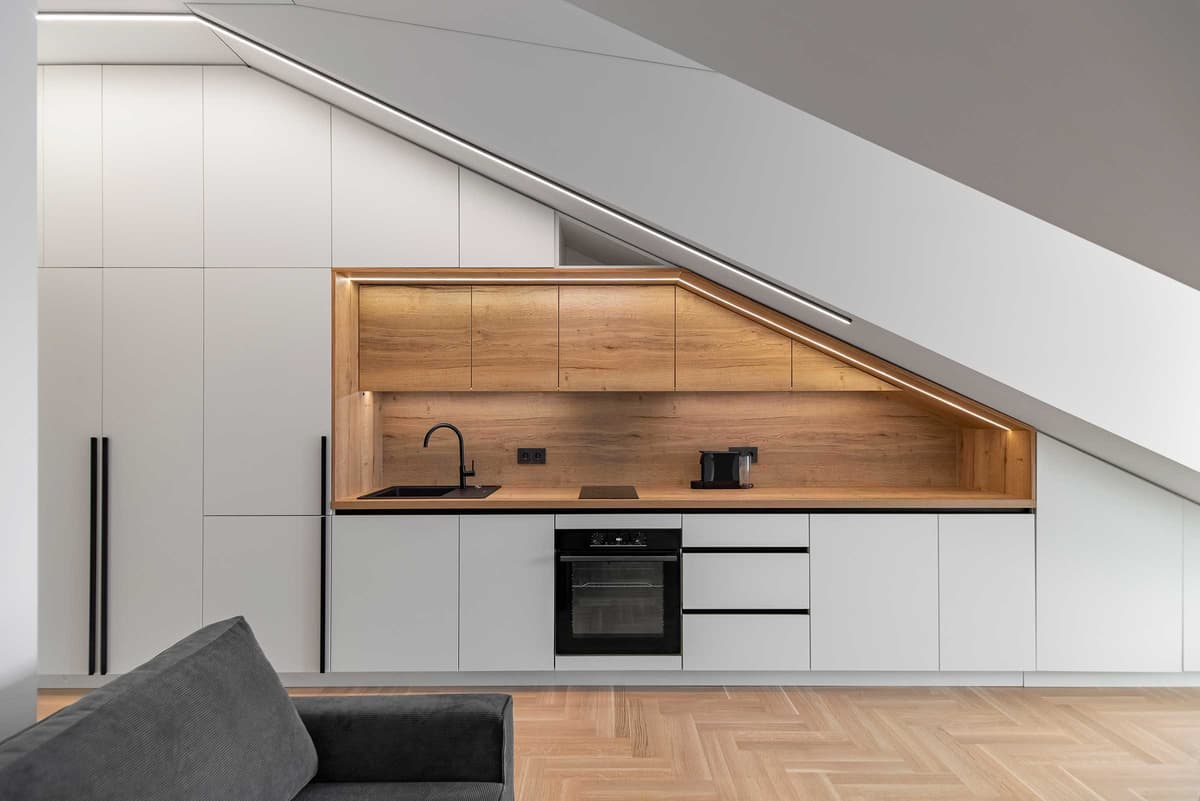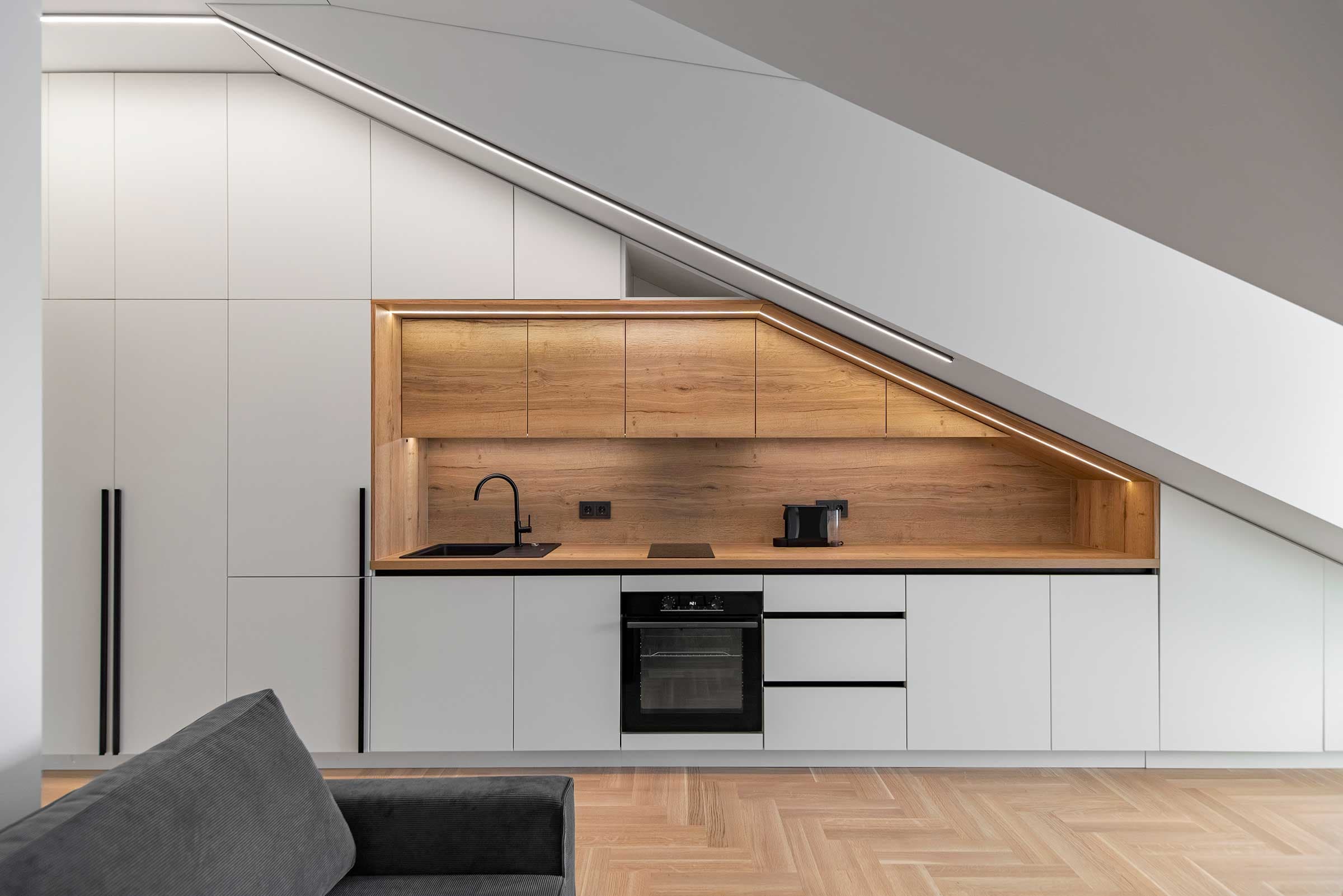
A custom kitchen is not built in a day. It's engineered in stages, each one building on validated data from the previous step. From our first contact to your installation day, here's exactly what happens — and why precision at each stage matters.
What Happens During the 3D Room Scan?
Our technician places a Leica 3D laser scanner in your kitchen and captures a complete point cloud in 15 minutes. The scanner fires pulses that measure every surface — walls, floors, ceilings, windows, pipes, sockets, appliance cutouts — recording their exact position in 3D space with ±3 mm accuracy. The result: a digital twin of your room that captures every imperfection, every out-of-square corner, every ceiling variation. Nothing is estimated.
How Do CAD Engineers Design Against Real Geometry?
Our designers import the scanned room model into SolidWorks and create your kitchen within that digital space. Every cabinet, worktop, and pantry unit is designed against actual wall contours, not assumptions. A worktop that needs to follow a wall sloping 8 mm over 4 metres? The design accounts for it. A base cabinet that must fit under pipes? Their positions are known to the millimetre. This design-against-reality approach means fitting problems are solved on screen — where changes cost nothing — instead of on site.
What Does 5-Axis CNC Machining Enable?
Our 5-axis CNC machines cut cabinet panels, door frames, decorative edges, and routed details with tolerances held to ±0.5 mm. The five axes (X, Y, Z plus two rotational axes) allow us to cut complex joinery, angled edges, and detailed panel work in a single setup. This precision, combined with optimized nesting algorithms, reduces material waste by 15–20% compared to traditional cutting methods. As of 2026, 5-axis capability is still not standard in Lithuanian custom furniture — it's what separates engineered precision from hand-fitted approximation.
How Is Edge Banding Applied?
After CNC cutting, every visible panel edge receives a matching edge band — a thin strip of material (veneer, plastic, or solid wood) that's heat-applied to the edge and trimmed flush. Modern edge banders seal the edge, improve durability, and deliver the finished appearance. The process takes seconds per part and is critical for kitchen cabinets that endure moisture, temperature cycling, and heavy use.
What's the Timeline from Scan to Installation?
| Phase | Duration | What Happens |
|---|---|---|
| 3D Scanning | 15 minutes | Room geometry captured, point cloud processed |
| CAD Design & Review | 3–5 days | Kitchen designed, client reviews, revisions finalized |
| Production Planning | 1–2 days | CNC programs generated, materials scheduled, nesting optimized |
| CNC Cutting & Assembly | 2–3 weeks | Parts machined, edge banding applied, cabinets assembled, hardware installed |
| Quality Inspection | 2–3 days | Dimensional verification, finish inspection, function testing |
| Delivery & Installation | 1–2 days | On-site assembly, worktop installation, final calibration |
| Total | 28–35 days | From initial scan to fully installed custom kitchen |
How Does the Production Workflow Ensure Fit?
Here's how each step builds on the previous one:
- Scan: Room geometry captured as a point cloud (±3 mm accuracy)
- Design: Kitchen modeled in CAD against the scanned geometry, client approved
- Validation: Design reviewed by production team to confirm CNC feasibility and part sequencing
- Programming: CAD model converted to CNC tool paths, nesting algorithm optimizes panel layout
- Cutting: CNC machines execute the programs with ±0.5 mm tolerance, waste minimized
- Assembly: Cabinet frames assembled with pocket-hole joinery, panels installed, hardware mounted
- Edge Finishing: Visible edges banded, sanded, and finished
- Inspection: Every cabinet checked against design specifications before shipment
- Installation: Cabinets unpacked, positioned, leveled, and secured; worktops fitted and sealed; appliances integrated; final adjustments made
At no point is the installation team guessing. The kitchen was designed to your actual room, manufactured to validated tolerances, and arrives ready to assemble.
What Tolerances Matter in a Custom Kitchen?
- Wall measurement: ±3 mm (from 3D scan)
- CNC machining: ±0.5 mm on critical dimensions
- Cabinet assembly: ±1 mm on frame squareness
- Worktop fit: ±2 mm gap to walls (sealed with silicone)
- Door alignment: ±1 mm side-to-side, ±0.5 mm top-to-bottom
- Appliance cutouts: ±2 mm (accommodates standard appliance tolerances)
These tolerances mean your kitchen is not merely "close enough" — it's engineered to fit without shimming, gap-filling, or site trimming.
What Can Go Wrong, and How Does 3D Scanning Prevent It?
Traditional kitchens designed from manual measurements encounter these common failures:
- Uneven worktops: Walls slope by 10–15 mm; designer assumed straight walls → worktop rocks, gaps appear at edges
- Appliance cutouts too small: Hidden pipes or sockets discovered during installation → appliance doesn't fit, cabinet needs rework
- Cabinet tilting: Sloped floors not measured → tall cabinets appear off-vertical, doors don't hang straight
- Poor door clearance: Window frames or architectural features not accounted for → cabinet doors hit walls when opened
- Worktop misalignment: Island doesn't align with adjacent runs → visible step or gap in counters
3D scanning eliminates these because the design process sees your actual room, not a standardized room.
What Happens After Installation?
Your kitchen receives a 12-month warranty covering workmanship and materials. We provide a care guide for your specific materials (solid wood, veneer, lacquer, or melamine), maintenance recommendations, and a direct contact for any questions. Most of our clients never need to call — the fit was right, the installation was clean, and the kitchen simply works.
Frequently Asked Questions
How long does a custom kitchen take from start to finish?
The complete timeline is typically 28–35 days: 15 minutes for 3D scanning, 3–5 days for CAD design and client review, 2–3 weeks for CNC production and assembly, 2–3 days for quality inspection, and 1–2 days for delivery and installation. Express timelines are available for additional cost.
What makes 5-axis CNC better than 3-axis for kitchen cabinets?
5-axis CNC allows complex joinery, angled decorative edges, and routed details to be cut in a single setup without manual repositioning. This means higher precision (±0.5 mm tolerance), faster production, less handling damage, and unique design possibilities that 3-axis machines cannot achieve.
Can 3D scanning work in old buildings with uneven walls?
Absolutely. Old buildings with uneven walls, sloped floors, and non-square corners are exactly where 3D scanning delivers the most value. The scanner captures every deviation; the design accounts for it. A heritage flat with 30 mm of variation across a 4-metre wall run is handled precisely, not approximated.
What's included in the warranty after installation?
FurniOx kitchens come with a 12-month workmanship and materials warranty covering all components, joints, hardware, and finishes. This includes free adjustments (door alignment, hinge tuning, hardware tightening) within the first year. Extended warranties are available for finishes and structural components.
How does waste reduction work with CNC nesting?
Our CNC nesting algorithm arranges all cabinet panels to minimize scrap. By rotating and repositioning parts intelligently, we reduce waste by 15–20% compared to manual layout. The saved material reduces your cost and our environmental footprint — a win on both sides.