Why Do Manual Measurements Fail?
Every custom furniture project starts with measuring the space. Traditionally, this means a carpenter with a tape measure, a notepad, and a pencil. The approach has worked for centuries — until it doesn't.
Manual measurements miss what the human eye cannot detect:
- Wall irregularities — surfaces that look flat but bow by 5-15 mm over a 3-metre span
- Floor slopes — gradients invisible to the eye but critical for tall cabinets and fitted wardrobes
- Hidden pipes and sockets — positions estimated rather than mapped precisely
- Ceiling variations — especially in older buildings where no two corners share the same height
- Angled walls — slight deviations from 90° that compound across a full kitchen or wardrobe run
The result? Furniture arrives on installation day and doesn't fit. Gaps appear. Panels need trimming on site. Worktops don't meet walls cleanly. The client sees the problem; the manufacturer scrambles to fix it.
This is the exact cycle we experienced as furniture buyers before founding FurniOx. And it's the cycle we set out to break.
How Did We Pioneer 3D Scanning in Lithuania?
We were among the first furniture manufacturers in Lithuania to integrate laser 3D scanning into bespoke furniture production. The decision wasn't driven by a desire to appear innovative — it was driven by frustration with the failures we kept seeing in projects where manual measurement was the only option.
The investment in a Leica 3D scanner was significant for a company of our size, but the return was immediate: fewer fitting problems, fewer site visits, fewer rework hours, and significantly less installation-day stress for both our team and clients.
How 3D Scanning Works in Our Process
Step 1: Room Capture
Our technician places the Leica scanner in the room and captures a complete 3D point cloud in minutes. The scanner fires laser pulses that bounce off every surface — walls, floors, ceilings, window frames, pipes, radiators, electrical sockets — and records their exact position in three-dimensional space.
The result is a dense cloud of millions of measured points, each with sub-millimetre positional accuracy (within ±3 mm across the full room volume).
Step 2: Point Cloud Processing
The raw point cloud is processed into a clean 3D model of the room. This digital twin captures every surface irregularity, every deviation from square, every hidden obstruction. Nothing is estimated. Nothing is approximated.
Our CAD engineers can measure any distance, any angle, any clearance directly from this model — with confidence that the measurements reflect reality, not assumption.
Step 3: Design Against Real Geometry
This is where the real value emerges. When our designers create furniture in SolidWorks CAD, they design against the actual room geometry captured by the scanner. The CAD model and the room model exist in the same digital space.
This means:
- A kitchen worktop is designed to follow the actual wall contour, not an assumed straight line
- A fitted wardrobe accounts for a ceiling that drops 12 mm from left to right
- A bathroom vanity routes around pipes whose positions are mapped to the millimetre
- A corner cabinet compensates for walls that meet at 91.3° instead of the assumed 90°
Every potential fitting problem is identified and resolved on screen — where changes cost nothing — instead of on site, where corrections cost time, materials, and client trust.
Step 4: Validated Production
Because the design is validated against real room data, the CNC programs generated from CAD are accurate from the start. Parts arrive at the installation site knowing they will fit. The installer's job shifts from problem-solving to assembly.
What's the Real Difference Before vs After 3D Scanning?
Before 3D Scanning
- Carpenter measures room with tape measure (15-30 minutes)
- Measurements transferred to paper or spreadsheet
- Designer works from numbers, assumes walls are straight and corners are square
- Production based on assumed geometry
- Installation reveals fitting problems
- On-site trimming, shimming, and rework
- Client sees the compromises
After 3D Scanning
- Technician scans room with Leica scanner (10-15 minutes)
- Complete room geometry available as 3D model
- Designer works against actual room surfaces
- Problems identified and solved digitally
- Production based on validated geometry
- Installation is predictable assembly, not problem-solving
- Client sees precision
When Does 3D Scanning Matter Most?
Not every project requires 3D scanning. A simple freestanding bookshelf in a modern apartment with straight walls? Manual measurement is fine.
But scanning becomes essential for:
- Fitted kitchens with long worktop runs along potentially uneven walls
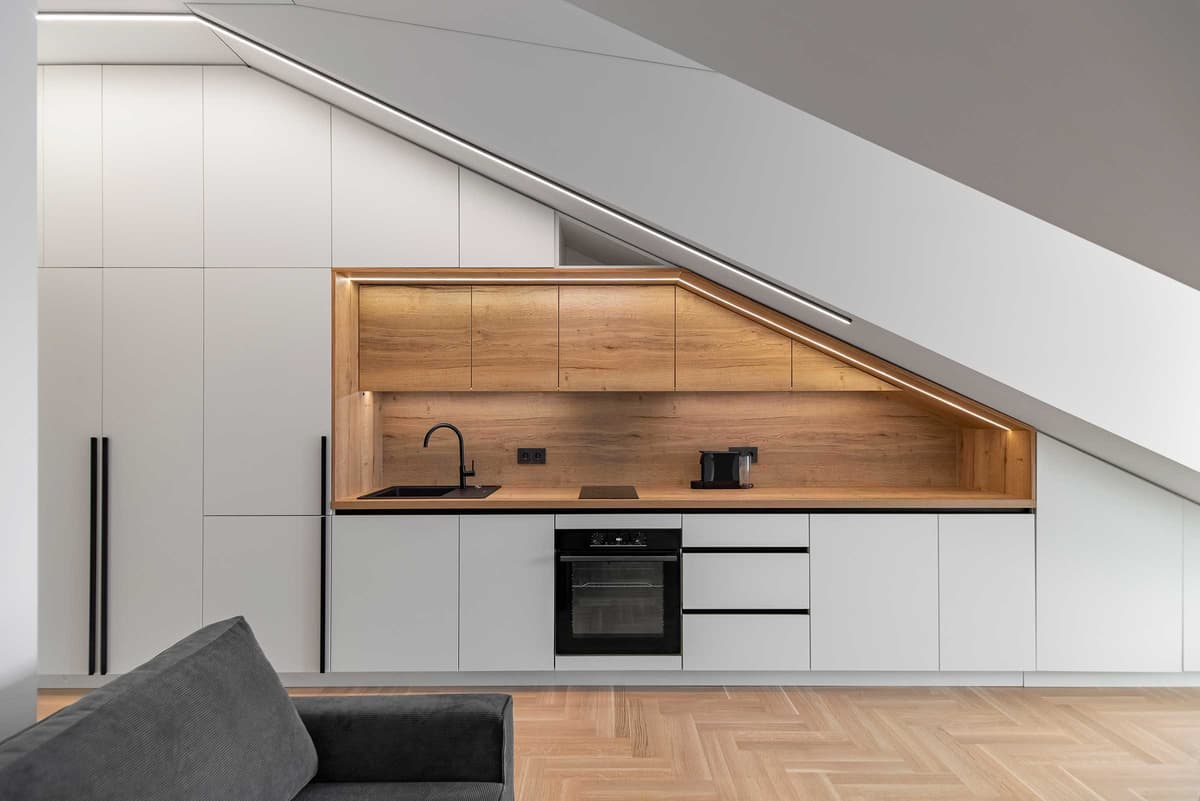
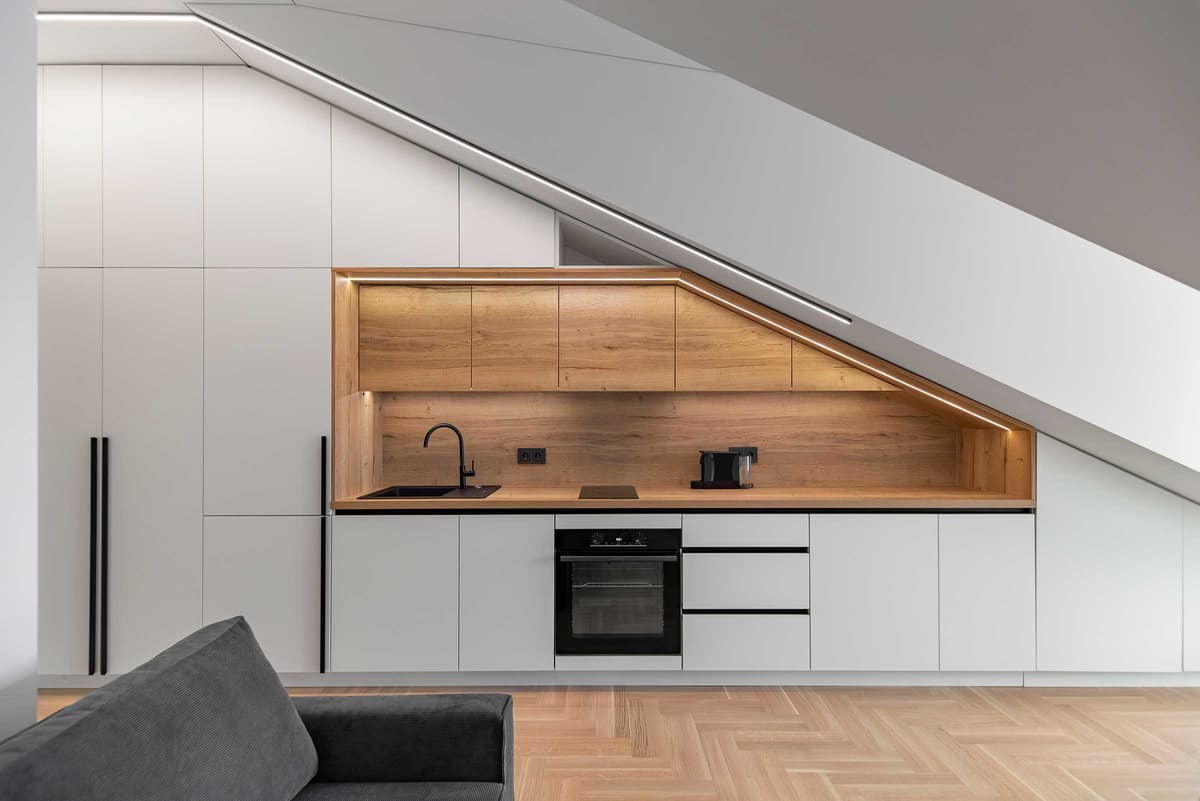
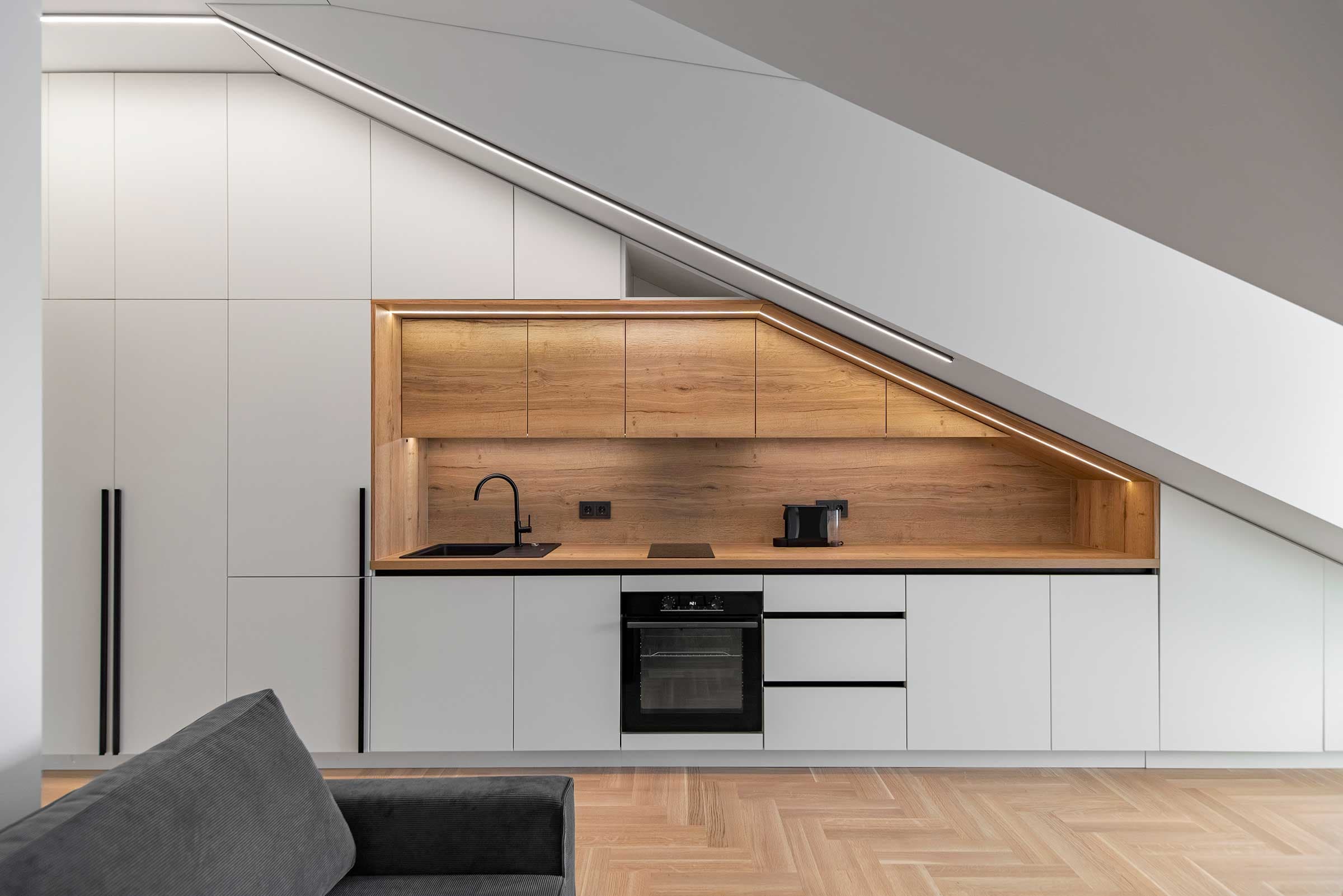
- Walk-in wardrobes under sloped ceilings or in attic spaces
- Bathroom vanities that must route around fixed plumbing
- Commercial fit-outs where multiple furniture elements must align across a large space
- Heritage buildings where nothing is straight, square, or level
- High-value projects where rework costs are unacceptable
What's the ROI for Clients?
The investment in 3D scanning pays for itself through:
- Eliminated fitting issues — the number one source of client dissatisfaction in custom furniture
- Fewer site visits — no need for return measurement trips when the first scan captures everything
- Reduced waste — parts are cut correctly the first time, with no on-site trimming offcuts
- Faster installation — installers assemble rather than adjust, cutting installation time significantly
- Higher client confidence — seeing your room as a 3D model with furniture placed inside it, before production begins, changes the conversation entirely
Is 3D Scanning Replacing Skilled Craftspeople?
We don't see 3D scanning as replacing skilled craftspeople. The scanner captures data; humans interpret it, design with it, and make the judgment calls that turn accurate measurements into beautiful furniture.
This is the Industry 5.0 principle we follow at FurniOx: use technology to remove the avoidable errors and guesswork, so skilled people can focus on what they do best — creating furniture that looks right, feels right, and fits perfectly.
The scanner doesn't replace the carpenter's eye for proportion and detail. It simply ensures that when the carpenter's eye says "this looks perfect," the measurements confirm it actually is.
Where Are We Heading Next?
3D scanning is one piece of our connected production workflow. From scan to SolidWorks CAD to 5-axis CNC machining, each step builds on validated data from the previous one. The goal is not technology for its own sake — it's furniture that fits, delivered on time, with fewer surprises for everyone involved.
If you're planning a project where fit matters — and it usually does — contact us to discuss how our scanning-first approach can make the difference.
Frequently Asked Questions
What is 3D scanning accuracy for furniture?
Modern laser scanners like the Leica achieve sub-millimetre accuracy within ±3 mm across the entire room volume. This precision captures wall irregularities, ceiling variations, and obstacles invisible to manual measurement, ensuring furniture fits without site adjustments.
How long does a 3D room scan take?
A complete room scan typically takes 10–15 minutes with a laser scanner. The technician positions the device, captures a dense point cloud of millions of measured points, and processes it into a digital 3D model. Quick turnaround means minimal disruption to your space.
What problems does 3D scanning prevent?
3D scanning eliminates fitting failures caused by invisible wall irregularities, uneven floors, hidden pipes, ceiling variations, and non-square corners. These issues traditionally appear during installation, requiring expensive on-site trimming and rework that 3D scanning identifies and resolves digitally beforehand.
What equipment is used for furniture 3D scanning?
Professional 3D scanning uses laser scanners (such as Leica) that fire pulses to measure surface positions in three dimensions. The raw point cloud is then processed into a clean digital model using specialized software, imported into CAD tools like SolidWorks for furniture design.
Can 3D scanning work with any room shape?
Yes. 3D laser scanning captures every surface geometry regardless of complexity — sloped ceilings, angled walls, curved features, or irregular layouts. This makes it especially valuable for heritage buildings, attic spaces, and commercial fit-outs where non-standard dimensions are the norm.